Enterprise CRM Platform (Case Study)
Built around the idea that traditional CRMs fail under operational scale, fragmented workflows, and delayed decision-making, this platform pushed beyond dashboard-level software into a real-time operational intelligence system.
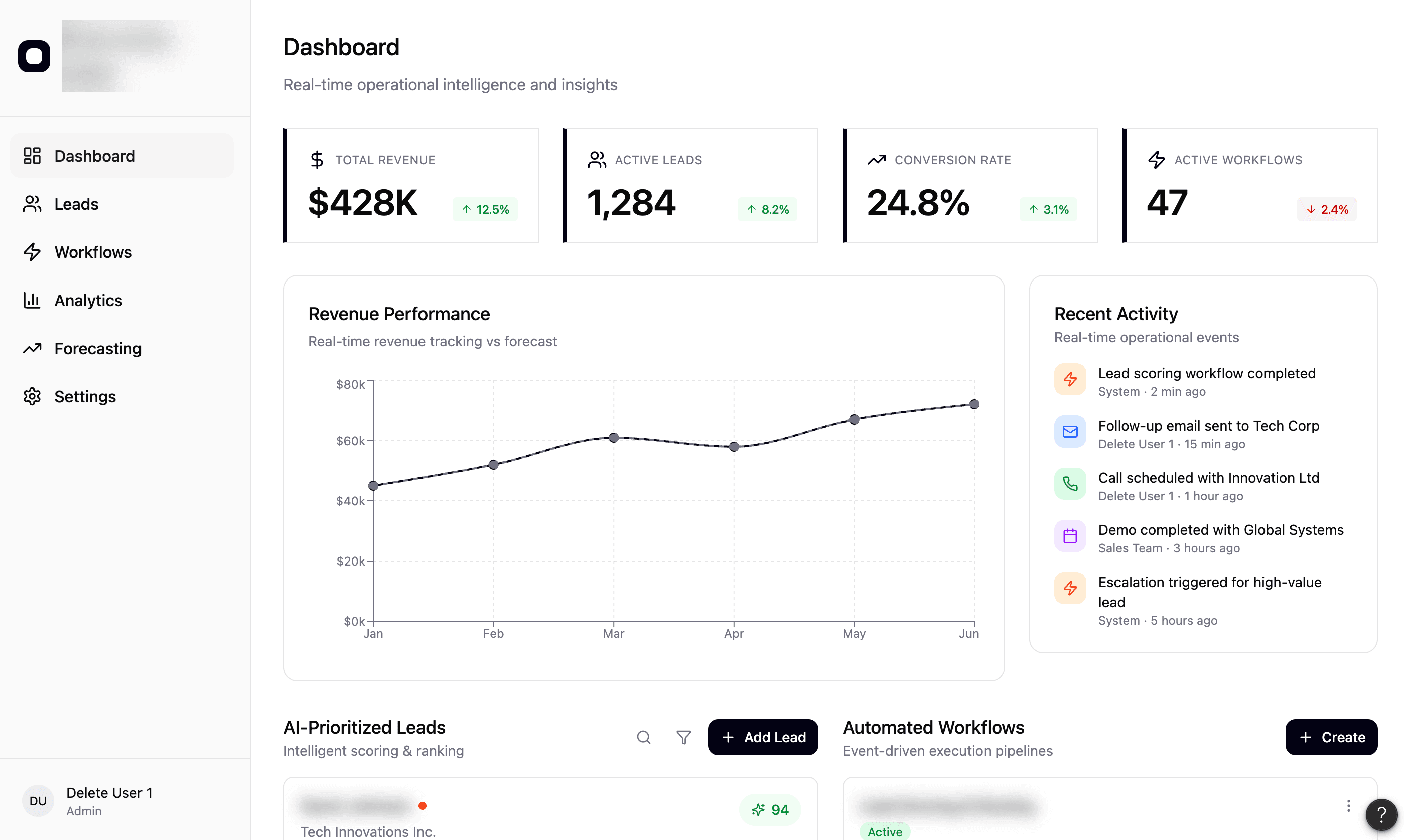
Instead of relying on static CRUD-heavy flows, the architecture leaned heavily into event-driven execution, distributed workflow handling, and live synchronization pipelines to eliminate operational latency across sales and business operations.
Workflow Automation at Scale
Complex business operations were transformed into automated execution pipelines powered by trigger-based workflow orchestration, asynchronous processing layers, and retry-safe background workers.
High-frequency operational tasks such as lead routing, escalation chains, activity synchronization, and automated follow-ups were executed through distributed job systems rather than synchronous request cycles — dramatically reducing response bottlenecks and manual dependency chains.
Queue-driven execution models, idempotent processing strategies, and state-aware workflow transitions enabled the platform to maintain operational consistency even under concurrent multi-user load.
AI-Assisted Decision Infrastructure
Instead of treating AI as a superficial chatbot layer, intelligence was embedded directly into operational decision systems.
Behavioral signals, transactional activity, and engagement patterns were continuously aggregated into adaptive scoring pipelines capable of prioritizing leads, estimating conversion probability, and surfacing high-value operational actions in real time.
The scoring architecture emphasized explainability, weighted inference systems, and dynamic recalculation models — allowing business teams to trust and operationalize AI-assisted decisions rather than treating them as black-box outputs.
Real-Time Analytics Engine
The analytics infrastructure was engineered around low-latency data visibility rather than delayed reporting snapshots.
Operational events were streamed into optimized aggregation pipelines powering live KPI dashboards, funnel analysis systems, revenue tracking, and performance monitoring engines.
WebSocket-based synchronization, cache-aware read models, and CQRS-inspired reporting patterns allowed dashboards to reflect operational state changes almost instantly, creating a near real-time decision environment across teams.
Enterprise RBAC & Multi-Tenant Isolation
Security and organizational scalability were treated as architectural primitives rather than post-development enhancements.
The authorization layer implemented policy-driven RBAC with tenant-scoped isolation, hierarchical permissions, and middleware-level access enforcement capable of supporting complex enterprise operational structures.
Permission abstractions, scoped API boundaries, and audit-oriented activity tracing ensured that sensitive operational data remained isolated, traceable, and secure across organizations and departments.
Performance & System Scalability
The platform architecture prioritized operational scalability from the foundation level.
Heavy read paths were optimized through intelligent caching strategies, aggregation-aware relational modeling, Prisma query optimization, and distributed processing layers capable of handling concurrent operational workloads efficiently.
Modular service boundaries, typed contracts, centralized observability, and fault-tolerant execution patterns enabled the system to scale without sacrificing maintainability or runtime reliability.
Engineering Footprint
The platform combined Next.js, React, TypeScript, Node.js, Prisma, PostgreSQL, Redis, WebSockets, and distributed background processing systems into a production-oriented architecture optimized for enterprise operational throughput.
Rather than functioning as a conventional CRM, the system evolved into a real-time operational command layer capable of automating workflows, amplifying business visibility, and accelerating organizational decision velocity at scale.